Homophones KS2
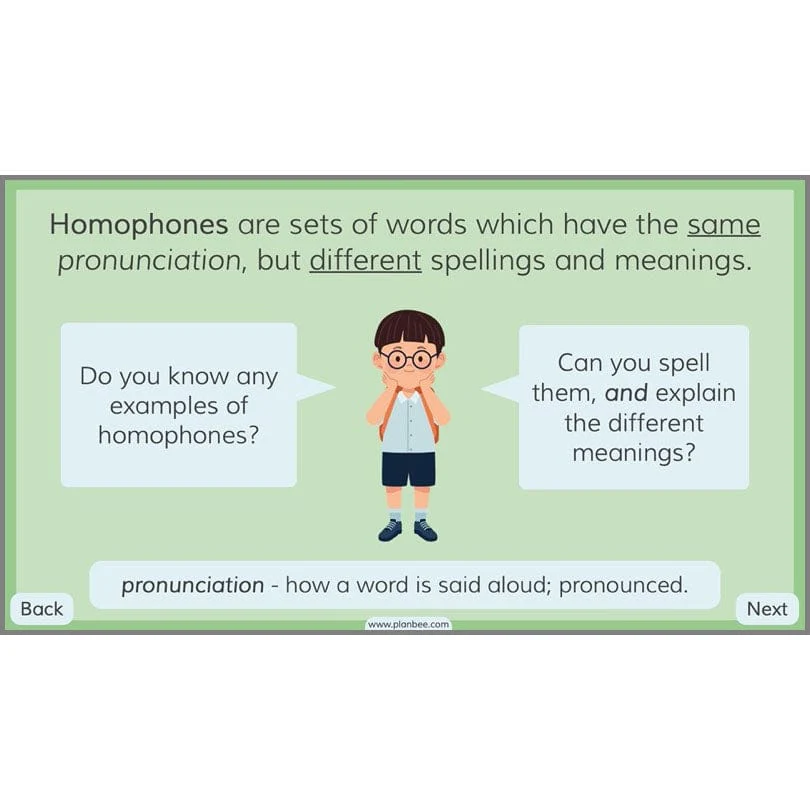
This homophones KS2 lesson introduces your class to words that sound the same but have different meanings and spellings. Children will explore common homophones such as ‘there’, ‘their’ and ‘they’re’, or ‘to’, ‘too’ and ‘two’, learning how choosing the correct spelling helps to make writing clear, accurate and easy for the reader to understand.
Lesson 1: Homophones
Is it peace or piece? Write or right? Allowed or aloud? This ready-to-teach Homophones KS2 lesson gives your Year 3 class lots of practice at identifying and spelling a range of homophones.
During the teaching input, children are challenged to match and define homophone pairs, find missing homophones within a given sentence, and identify when an incorrect homophone has been used. In their independent activities, children apply what they have learnt by first matching homophone pairs, and then composing their own sentences with them, using the correct spelling according to the intended meaning. In the alternative activity, children create a class book of homophones, complete with definitions and examples, which can be added to whenever new homophones are discovered.
Everything you need is included within this Homophones KS2 English lesson pack - a detailed plan, an informative set of PDF slides for the teaching input, engaging activity ideas and printable resources.
What's included:
- Lesson plan
- Slides
- Activity ideas
- Differentiated worksheets
- Homophones Cards
- Homophones Booklet Pages
Original: $4.71
-65%$4.71
$1.65More Images



Homophones KS2
This homophones KS2 lesson introduces your class to words that sound the same but have different meanings and spellings. Children will explore common homophones such as ‘there’, ‘their’ and ‘they’re’, or ‘to’, ‘too’ and ‘two’, learning how choosing the correct spelling helps to make writing clear, accurate and easy for the reader to understand.
Lesson 1: Homophones
Is it peace or piece? Write or right? Allowed or aloud? This ready-to-teach Homophones KS2 lesson gives your Year 3 class lots of practice at identifying and spelling a range of homophones.
During the teaching input, children are challenged to match and define homophone pairs, find missing homophones within a given sentence, and identify when an incorrect homophone has been used. In their independent activities, children apply what they have learnt by first matching homophone pairs, and then composing their own sentences with them, using the correct spelling according to the intended meaning. In the alternative activity, children create a class book of homophones, complete with definitions and examples, which can be added to whenever new homophones are discovered.
Everything you need is included within this Homophones KS2 English lesson pack - a detailed plan, an informative set of PDF slides for the teaching input, engaging activity ideas and printable resources.
What's included:
- Lesson plan
- Slides
- Activity ideas
- Differentiated worksheets
- Homophones Cards
- Homophones Booklet Pages
Product Information
Product Information
Shipping & Returns
Shipping & Returns
Description
This homophones KS2 lesson introduces your class to words that sound the same but have different meanings and spellings. Children will explore common homophones such as ‘there’, ‘their’ and ‘they’re’, or ‘to’, ‘too’ and ‘two’, learning how choosing the correct spelling helps to make writing clear, accurate and easy for the reader to understand.
Lesson 1: Homophones
Is it peace or piece? Write or right? Allowed or aloud? This ready-to-teach Homophones KS2 lesson gives your Year 3 class lots of practice at identifying and spelling a range of homophones.
During the teaching input, children are challenged to match and define homophone pairs, find missing homophones within a given sentence, and identify when an incorrect homophone has been used. In their independent activities, children apply what they have learnt by first matching homophone pairs, and then composing their own sentences with them, using the correct spelling according to the intended meaning. In the alternative activity, children create a class book of homophones, complete with definitions and examples, which can be added to whenever new homophones are discovered.
Everything you need is included within this Homophones KS2 English lesson pack - a detailed plan, an informative set of PDF slides for the teaching input, engaging activity ideas and printable resources.
What's included:
- Lesson plan
- Slides
- Activity ideas
- Differentiated worksheets
- Homophones Cards
- Homophones Booklet Pages